


Table of Contents
- Why Indoor Pet Enrichment Matters
- Best Puzzle Toys for Dogs
- DIY Indoor Dog Enrichment Ideas
- How to Keep a Dog Entertained Indoors
- Enrichment for Rainy and Winter Weather
- Safety and Supervision Guidelines
- Measuring Enrichment Success
- Conclusion
- Frequently Asked Questions
Last Updated: October 2, 2026
Why Indoor Pet Enrichment Matters
Indoor pet enrichment keeps dogs mentally stimulated and prevents boredom-related behavioural problems. Dogs left without mental challenges often develop destructive habits: chewing furniture, excessive barking, or anxiety. Mental stimulation through interactive play, problem-solving games, and training sessions addresses this gap directly.
Indoor pet enrichment is essential for your dog's wellbeing, especially during winter or rainy weather when outdoor time is limited. A mentally stimulated dog is calmer, more obedient, and less likely to develop behavioural issues.
Enrichment activities build confidence, strengthen your bond, and improve impulse control and trainability.
Best Puzzle Toys for Dogs
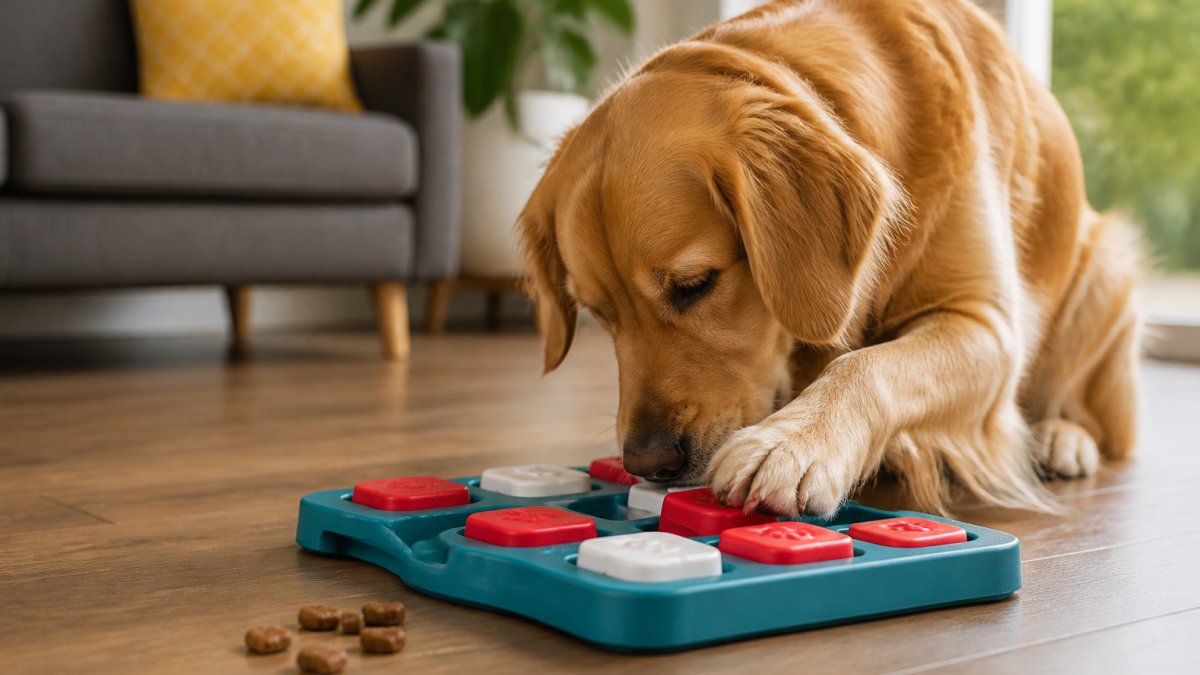
Puzzle toys engage your dog's natural problem-solving instincts and are among the most effective indoor enrichment tools. They require your dog to work for treats or kibble, slow eating, aid digestion, and provide cognitive engagement.
Understanding Puzzle Toy Categories and Difficulty Levels
Puzzle toys fall into three broad difficulty tiers, and matching your dog's current ability to the right tier prevents frustration and abandonment.
Beginner (Level 1): Simple treat-dispensing balls like the Kong Wobbler require minimal manipulation. Most dogs grasp the concept within 2-3 attempts.
Intermediate (Level 2): Sliding puzzles and rotating feeders like Nina Ottosson Level 2 require your dog to move compartments or lift covers. These maintain engagement for 15-25 minutes and suit dogs with prior puzzle experience.
Advanced (Level 3): Multi-step puzzles like Nina Ottosson Level 3 require sequential problem-solving. Best for dogs with 2+ weeks of puzzle experience.
Budget-Friendly Versus Store-Bought: When to DIY
Not every puzzle toy requires a purchase. Household items can replicate beginner and intermediate difficulty effectively:
- Muffin tin puzzle: Place treats in a standard muffin tin and cover each cup with a tennis ball. Your dog must remove the balls to access treats. Cost: £0 (using items you own). Difficulty: Beginner to Intermediate.
- Toilet roll tube: Stuff a cardboard tube with treats and fold the ends closed. Your dog tears the tube apart to find rewards. Cost: £0. Difficulty: Beginner. Caution: supervise to prevent ingestion of cardboard.
- Plastic bottle in a sock: Place a plastic bottle inside a sock and hide treats inside the bottle. Your dog manipulates the sock to access the bottle and extract treats. Cost: £0. Difficulty: Beginner to Intermediate.
DIY options work well initially but wear out quickly and pose choking hazards.
Rotation and Novelty Strategy
Puzzle toys lose effectiveness through habituation. Rotate toys on a 2-3 week cycle to maintain novelty. Maintain a roster of 4-6 puzzles at different difficulty levels to match your dog's mood and energy without constant purchases.
Safety and Maintenance
Inspect puzzle toys weekly for damage and replace immediately if cracked. Supervise initial interactions and step back to easier tiers if your dog abandons puzzles. Clean regularly with warm soapy water and dry completely before refilling.
DIY Indoor Dog Enrichment Ideas
DIY enrichment taps into natural behaviours: foraging, digging, and hunting. Snuffle mats hide treats in fabric for foraging. Towel games roll treats inside towels for unrolling. Dig boxes filled with sand or paper redirect digging. Frozen treats in Kong toys provide 20-30 minutes of engagement. Scent work games hide treats around your home, building confidence through smell. Rotate games weekly to maintain novelty.
How to Keep a Dog Entertained Indoors
Keeping your dog entertained indoors requires variety and consistency. A single activity becomes boring quickly; rotation prevents habituation. Alternate between puzzle toys, DIY games, training sessions, and physical play throughout the day.
Scent Work and Nose Games
Scent work leverages your dog's 300 million olfactory receptors. Start with hide-and-seek games where your dog watches you hide treats, then progress to hiding items out of sight. Even 10 minutes of focused scent work provides more mental stimulation than an hour of casual walking.
Training Sessions as Mental Stimulation
Training is powerful enrichment. Short, frequent sessions work better than long ones. Teach new commands or tricks like "play dead" or "spin" to build confidence and impulse control. Consistent daily training creates structure that reduces anxiety and prevents boredom-related behaviours.
Enrichment for Rainy and Winter Weather
Rainy days and winter weather limit outdoor time, making indoor enrichment essential. Enrichment needs vary significantly by age and mobility level.
Enrichment for High-Energy Dogs During Seasonal Confinement
Young, healthy dogs require varied, intense activities. Combine training sessions, puzzle toys, and DIY games throughout the day.
Low-Impact Enrichment for Senior Dogs and Limited Mobility
Senior dogs and those with joint problems, arthritis, or mobility limitations require enrichment strategies that engage the mind without stressing the body.
Scent work and nose games are ideal for senior dogs. These activities require minimal physical exertion, your dog works primarily through smell and gentle movement.
Snuffle mats and foraging toys suit senior dogs perfectly. Layer fabric strips or old towels into a mat base, then hide small treats throughout.
Puzzle feeders at ground level eliminate jumping or reaching.
Gentle training sessions build mental engagement without physical demand. Teach new commands, refine existing ones, or work on tricks that don't require jumping or rapid movement.
Tactile enrichment is often overlooked for senior dogs. Provide textured mats, blankets, or cushions in different materials.
Monitoring for Overexertion in Senior and Mobility-Limited Dogs
Watch for signs of overexertion, particularly with senior dogs or those with limited mobility. Enrichment should be enjoyable, not exhausting.
Senior dogs need more recovery time between enrichment sessions.
Seasonal Enrichment Planning
Create a seasonal enrichment plan tailored to your dog's age and mobility.
Safety and Supervision Guidelines
Supervision during enrichment activities prevents injuries and ensures your dog plays safely. Never leave your dog unsupervised with toys containing small parts that could be swallowed.
Inspect puzzle toys regularly for cracks, broken pieces, or sharp edges. Replace damaged toys immediately. Supervise initial interactions with new toys to ensure your dog engages appropriately rather than attempting to destroy them.
Monitor your dog's response to enrichment activities. Some dogs become frustrated rather than engaged with overly difficult puzzles. If your dog abandons a puzzle after a few minutes, the difficulty level is too high. Adjust accordingly.
Watch for signs of overexertion, particularly with senior dogs or those with limited mobility. Enrichment should be enjoyable, not exhausting. Elderly dogs benefit from gentler activities like snuffle mats and scent games rather than intense obstacle courses.
Measuring Enrichment Success
Enrichment success shows through observable behavioural changes. A properly enriched dog demonstrates improved focus, reduced destructive behaviour, and better impulse control. Track changes over 2-3 weeks to measure impact accurately.
Reduced destructive behaviour is the clearest indicator. If your dog previously chewed furniture or barked excessively, enrichment should decrease these behaviours noticeably. Document frequency before and after implementing enrichment activities.
Improved training responsiveness indicates enhanced mental engagement. Dogs receiving regular enrichment learn new commands faster and retain training better. Notice whether your dog responds more reliably to existing commands within weeks of starting enrichment.
Better sleep patterns suggest adequate mental stimulation. Dogs receiving sufficient enrichment sleep more soundly and for longer periods. Restlessness or excessive pacing indicates insufficient engagement.
Confidence building appears gradually. Shy or anxious dogs become more outgoing through enrichment activities. They approach new situations with less fear and interact more readily with family members.
Conclusion
Indoor pet enrichment transforms your dog's wellbeing, preventing boredom and behavioural problems while building confidence and mental resilience. Whether you choose puzzle toys, DIY games, scent work, or training sessions, consistency and variety drive results. The investment in your dog's mental stimulation pays dividends through a calmer, happier, more obedient companion.
Quanolo offers a curated selection of innovative, practical solutions designed to simplify and enhance your everyday life. From clever home repair tools and smart kitchen gadgets to cozy comfort essentials and pet care products, our range is built to solve common household annoyances with ease. We are dedicated to proving that high-quality, functional design should be accessible to everyone, helping you transform your living space into a sanctuary of order and tranquility. Shop now and discover how simple enrichment transforms your dog's indoor experience.
Frequently Asked Questions
What are the best indoor enrichment activities for dogs?
The most effective indoor pet enrichment combines mental stimulation, physical activity, and sensory engagement. Puzzle toys, scent work games, hide-and-seek, training sessions, and DIY enrichment like snuffle mats all provide strong cognitive function benefits. Rotating activities prevents boredom and keeps your dog engaged. Most dogs benefit from 30 minutes to 2 hours of structured enrichment daily, depending on age and energy level.
How can I keep my dog mentally stimulated indoors without spending a lot?
DIY indoor dog enrichment ideas are highly effective and cost-effective. Hide treats in a towel, create a dig box with blankets and toys, use muffin tins with tennis balls, or scatter kibble on a snuffle mat. Training sessions also provide excellent mental stimulation at no cost. These budget-friendly options build problem-solving skills and provide sensory engagement comparable to store-bought puzzle toys.
Do enrichment activities help with pet anxiety?
Yes. Mental stimulation and interactive play help dogs decompress and build confidence. Enrichment activities reduce stress-related behaviours by redirecting energy toward positive reinforcement and problem-solving. Dogs with anxiety often benefit from scent work, which engages their natural foraging instincts and provides calming sensory engagement. Regular enrichment supports overall behavioural welfare and emotional wellbeing.
Are puzzle toys effective for pet enrichment?
Puzzle toys are highly effective for cognitive function and problem-solving. They slow food consumption, encourage independent play, and provide sustained mental engagement. The best puzzle toys for dogs match your dog's ability level and reward effort with treats. Rotating puzzle toys prevents habituation and maintains novelty. Supervise use to ensure safety and check that pieces remain intact.