


Table of Contents
- Understanding Separation Anxiety and Mental Enrichment
- How to Use Enrichment Toys for Separation Anxiety
- Types of Enrichment Toys That Reduce Anxiety
- How Long Should a Dog Play with Enrichment Toys
- Safety Considerations for Unsupervised Play
- Toy Rotation Schedules and Age-Specific Enrichment
- Post-Play Decompression and Calming Techniques
- Frequently Asked Questions
Last Updated: September 30, 2026
Understanding Separation Anxiety and Mental Enrichment
Separation anxiety manifests as destructive behaviour, excessive barking, or house-soiling when owners leave. Dog enrichment toys anxiety solutions address this by redirecting anxious energy into focused, rewarding activities that promote self-soothing and cognitive stimulation.
Dog enrichment toys for anxiety work by engaging your dog's natural problem-solving instincts. When a dog extracts treats from a puzzle feeder or snuffle mat, their brain releases dopamine, creating a competing behaviour: instead of pacing or chewing furniture, your dog channels anxiety into a productive task.
A dog with adequate mental stimulation shows measurably calmer behaviour patterns, fewer destructive habits, and better sleep quality. Veterinary behaviourists consistently recommend environmental enrichment as a first-line intervention alongside gradual desensitisation training.
How to Use Enrichment Toys for Separation Anxiety
Using enrichment toys effectively requires proper toy selection, introduction technique, and timing to create lasting behavioural change.
Starting with the right toy selection
Match toy difficulty to your dog's anxiety level and skill. Highly anxious dogs need immediate rewards: treat-dispensing toys with large openings or snuffle mats. Start with single-level puzzles and progress only after your dog reliably solves them within 5-10 minutes. For aggressive chewers, choose durable rubber options designed for heavy chewers.
Introduction and positive reinforcement
Introduce toys during calm moments at home, not during departure routines. Fill with high-value treats (chicken, cheese, salmon) rather than kibble. Sit nearby with calm presence, avoid hovering anxiously or excessive praise, which heightens arousal.
Once your dog engages reliably for 10+ minutes at home, use it during brief departures starting at 5 minutes, gradually extending duration to prevent the toy from signalling your departure.
Types of Enrichment Toys That Reduce Anxiety
Different toy categories address different aspects of anxiety. A comprehensive approach combines multiple types to match your dog's preferences and anxiety triggers.
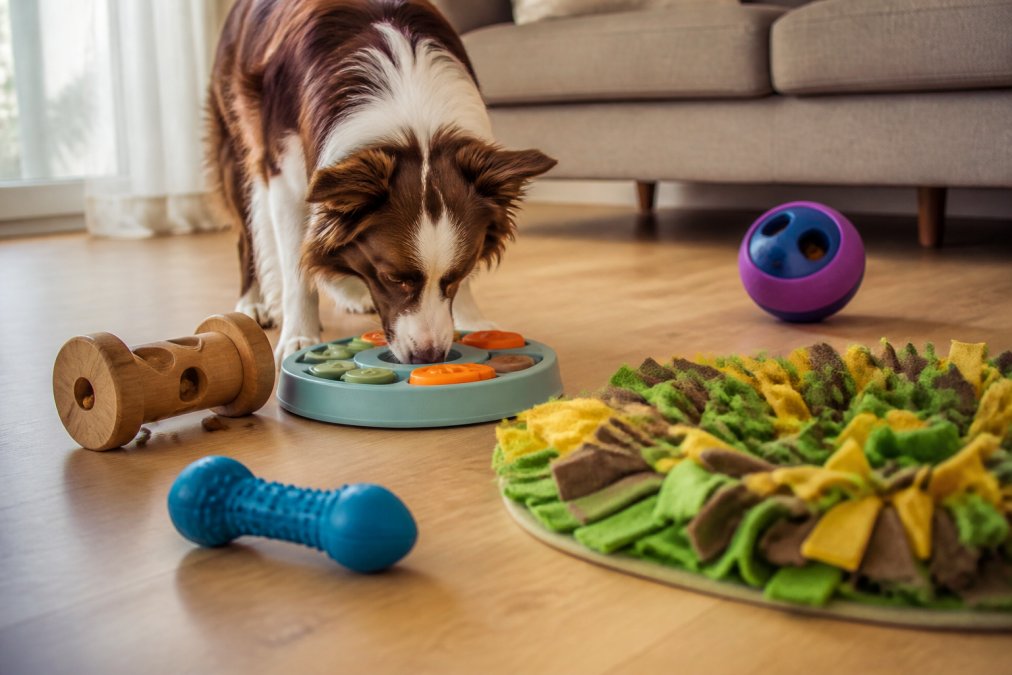
Puzzle feeders and treat-dispensing toys
Puzzle feeders engage problem-solving and shift focus from anxiety through cognitive effort. Start simple (rubber ball with a hole) for immediate success, progressing to complex multi-level puzzles. Aim for 15-30 minutes of engagement; extend duration by freezing treats or using peanut butter as a binder.
Long-lasting chew toys and durable rubber options
Chewing releases calming neurochemicals and redirects anxiety away from furniture. Choose durable natural rubber toys designed for heavy chewers, avoiding removable parts or splintering materials. Long-lasting chews (bully sticks, yak cheese, rubber rings) provide sustained engagement with meditative quality.
Snuffle mats and sensory engagement toys
Snuffle mats mimic natural foraging behaviour and engage instinctive patterns without failure states, building confidence for moderate anxiety. Rotate sensory toys (crinkle, squeak, varied textures) weekly to maintain novelty.
How Long Should a Dog Play with Enrichment Toys
Optimal enrichment duration varies by anxiety severity, toy type, and individual dog metabolism. Use a structured approach tied to your dog's anxiety baseline.
Duration by anxiety level and toy type
Mild anxiety: 15-20 minutes daily is typically sufficient. Shorter, consistent sessions work better than extended play.
Moderate anxiety: 25-40 minutes daily, split into two or three sessions. Stagger sessions so your dog doesn't anticipate your departure immediately after enrichment ends.
Severe anxiety: 45-60 minutes daily across multiple sessions, combined with professional training support. Enrichment alone is insufficient, concurrent work with a certified animal behaviourist is essential.
Measuring engagement and fatigue signals
Duration should be guided by your dog's engagement, not a fixed timer. Watch for these markers:
Active engagement: Manipulating toy, chewing steadily, searching for treats; ears forward, body loose, breathing normal. Declining interest: Intermittent checking or wandering, remove the toy to prevent teaching boredom. Fatigue: After 20-30 minutes, dogs naturally rest; lying down near the toy signals saturation. Frustration: Whining, rapid panting, or aggressive manipulation indicate the puzzle is too difficult, remove immediately and offer simpler option next time.
Frequency and consistency matter more than duration
Daily 20-minute sessions reduce anxiety more than sporadic 90-minute sessions. Consistency builds neural pathways; implement enrichment at the same times daily so your dog learns it's a reliable routine, not a response to departure.
Adjusting duration as anxiety improves
As anxiety reduces, faster disengagement signals progress. Gradually reduce duration rather than eliminating enrichment. If anxiety resurfaces, increase duration or introduce new toy types to prevent habituation.
Safety Considerations for Unsupervised Play
Never leave unsupervised toys with choking risks (removable parts, splintering, swallowable pieces). Inspect regularly and discard damaged toys immediately. Choose non-toxic materials (natural rubber, untreated wood, food-grade plastics). If your dog shows resource guarding, introduce toys only when alone.
Toy Rotation Schedules and Age-Specific Enrichment
Enrichment effectiveness depends on maintaining novelty through rotation and matching toy complexity to your dog's developmental stage and anxiety profile.
The neuroscience of toy rotation and habituation prevention
Dogs habituate to static stimuli within 2-4 weeks. Rotation prevents this habituation cycle, maintaining the dopamine response that makes enrichment anxiolytic (anxiety-reducing).
The three-group rotation system:
Divide your enrichment toys into three equal groups. Keep Group A accessible at all times; these are your "anchor" toys, the reliable options your dog engages with consistently (e.g., a durable rubber chew toy, a snuffle mat). Rotate Group B and Group C on a 7-14 day cycle.
- Week 1: Groups A + B accessible; Group C stored away
- Week 2: Groups A + C accessible; Group B stored away
- Week 3: Groups A + B accessible again; Group C stored away
This rhythm creates perceived novelty without requiring constant purchases. A toy your dog ignored after two weeks of constant access often becomes fascinating again after a 14-day absence, as their habituation resets.
Tracking engagement patterns:
Maintain a simple log of which toys your dog engages with most. Note duration, intensity, and whether engagement drops after a certain period.
Age-specific enrichment: developmental anxiety and cognitive capacity
Anxiety manifests differently across life stages, and enrichment strategy must adapt accordingly.
Seniors (7+ years): Cognitive decline and comfort
- Toy complexity: Simplify enrichment. Multi-level puzzles may frustrate a senior dog with declining problem-solving ability. Return to single-step treat dispensers, snuffle mats, and soft chews.
- Duration: 10-20 minutes per session, 1-2 times daily. Seniors tire more easily and may have reduced motivation for extended play.
- Treat strategy: Use softer treats to accommodate dental sensitivity. Avoid hard chews that may damage teeth or cause jaw pain. Frozen treats are often easier for seniors to engage with than room-temperature options.
- Anxiety trigger: Seniors often experience nighttime anxiety, confusion during darkness, or anxiety related to pain (arthritis, hearing loss). Offer enrichment during daylight hours when they're most alert. Provide comfort toys (heated mats, weighted blankets) alongside enrichment.
- Cognitive maintenance: Even simplified enrichment maintains neural pathways. A senior dog who engages with a snuffle mat for 10 minutes daily shows better cognitive function than one receiving no enrichment.
- Rotation strategy: Seniors may not habituate as quickly due to reduced novelty-seeking. Longer rotation cycles (21-28 days) often work well, with emphasis on consistency over novelty.
Rescue dogs and unknown anxiety histories
Rescue dogs often arrive with unknown anxiety backgrounds. Start with the simplest enrichment options (snuffle mats, soft chews) and progress gradually over 4-8 weeks. Some rescue dogs respond immediately to enrichment; others need weeks to build trust in toys and play. Patience during this adjustment period is essential.
Post-Play Decompression and Calming Techniques
Enrichment provides the tool; decompression teaches your dog how to transition from engaged activity back to calm rest. Without this final step, your dog may remain in an activated state even after the toy is removed.
Frequently Asked Questions
Do enrichment toys actually help with dog anxiety?
Yes. Enrichment toys provide mental stimulation and cognitive engagement that help redirect anxious energy into constructive activity. Puzzle feeders and treat-dispensing toys encourage problem-solving, which activates the reward centres in your dog's brain and promotes a calm state. Interactive enrichment reduces reactive behaviour and hyperactivity by occupying your dog's mind during periods when separation anxiety might otherwise escalate.
What are the best types of toys for dogs with separation anxiety?
Puzzle feeders, treat-dispensing toys, and long-lasting chew toys work best for anxious dogs. Durable rubber toys filled with treats encourage extended engagement, while snuffle mats provide sensory engagement through foraging. For nervous dogs, choose non-toxic materials and toys sized appropriately to your dog's chew intensity. Rotate toys regularly to maintain novelty and prevent boredom.
How long should a dog play with enrichment toys?
Most dogs benefit from 15-30 minutes of active enrichment play per session, depending on age and energy level. Puppies and younger dogs may need shorter sessions to avoid overstimulation, whilst adult dogs can sustain longer engagement. Monitor your dog for signs of fatigue or loss of interest, and always supervise initial play sessions. Distribute enrichment throughout the day rather than offering everything at once.
Are puzzle toys safe for dogs to use unsupervised?
Puzzle toys designed for unsupervised play are generally safe if they meet safety standards and match your dog's size and chew intensity. However, always inspect toys before use for damage or loose parts that could pose choking hazards. Start with supervised play to ensure your dog understands how to use the toy safely. Remove toys if your dog shows signs of frustration or aggression, and choose non-toxic, durable materials.