


Table of Contents
- Understanding Signs of Cat Boredom
- Daily Playtime for Cats: How Much Is Enough?
- Interactive Play Sessions That Keep Cats Engaged
- Best Interactive Cat Toys and Puzzle Feeders
- How to Catify Your Home for Environmental Enrichment
- Enrichment Strategies for Senior Cats and Multi-Cat Homes
- Rotating Toys and Preventing Boredom Long-Term
- Frequently Asked Questions
Last Updated: September 25, 2026
Understanding Signs of Cat Boredom
A bored cat isn't just a quiet cat, it's a frustrated one. To keep indoor cats entertained and prevent boredom, which manifests as destructive behaviour, excessive vocalization, and sometimes even aggression, requires deliberate enrichment. The signs are unmistakable once you know what to look for: scratching furniture beyond normal maintenance, attacking your hands during petting, or pacing repetitively through the same routes around your home.
Many cat owners mistake these behaviours for personality quirks rather than distress signals. Indoor cats lack the natural stimulation their wild counterparts experience through hunting, territory exploration, and environmental challenges. Without deliberate enrichment, they develop stress-related habits that damage your home and their health.
The connection between boredom and behavioural problems is direct. Cats with insufficient mental and physical stimulation show higher rates of inappropriate elimination, aggression, and obsessive grooming. Providing consistent environmental enrichment and interactive play isn't a luxury, it's essential for your cat's cognitive health and wellbeing.
Daily Playtime for Cats: How Much Is Enough?
Most indoor cats need 15 to 30 minutes of active play spread across two or three sessions daily. This duration mirrors the hunting patterns of wild cats, who engage in multiple short bursts of intense activity rather than one long session.
The key is consistency. A cat that receives 10 minutes of focused play each morning and evening will show measurably better behaviour and lower stress levels than one that gets sporadic 30-minute sessions. Cats thrive on routine, they anticipate playtime and build their day around it.
Age matters significantly. Kittens and young adults (under 5 years) need more vigorous play to burn energy, while senior cats benefit from gentler, shorter sessions that don't strain their joints. Even a 10-minute play session with a senior cat provides valuable cognitive stimulation and gentle movement.
The type of play matters as much as the duration. Interactive play where you're actively engaging your cat, using wand toys, laser pointers, or ball toys, is far more effective than leaving your cat alone with toys. Your participation creates the prey-chase dynamic that satisfies their hunting instinct.
Interactive Play Sessions That Keep Cats Engaged
Interactive play sessions are where you actively participate in your cat's entertainment. This isn't passive, you're the one creating movement, unpredictability, and the chase dynamic that cats find irresistible.
Wand toys and prey simulation
Wand toys replicate the movement patterns of actual prey. A feather or string attached to a wand creates the erratic, unpredictable motion that triggers a cat's predatory response. The best wand toy sessions mimic real hunting: slow stalking phases followed by explosive bursts of speed.
Vary your technique. Let the toy move slowly across the floor for stalking practice, then whip it upward to trigger jumping. Pause occasionally so your cat can "catch" the toy, this reward reinforces the hunting behaviour and keeps motivation high. A 5-10 minute wand toy session exhausts most cats more effectively than 20 minutes of chasing a stationary toy.
Rotate different wand toys to maintain novelty. A toy your cat ignored three weeks ago becomes fascinating again after a break. Store toys in a closed cupboard between sessions so they don't become background clutter.
Clicker training for mental stimulation
Clicker training isn't just for dogs. Cats respond powerfully to the clicker sound paired with immediate rewards, and the training process itself provides intense cognitive stimulation.
Start with basic behaviours: touching your hand with their nose, sitting on command, or jumping through a hoop. The clicker marks the exact moment your cat performs the desired behaviour, followed immediately by a treat. This creates a clear cause-and-effect loop that cats find deeply satisfying.
The mental engagement from clicker training often exhausts a cat more effectively than physical play alone. A 10-minute clicker training session can keep a cat mentally stimulated for hours afterward. Beyond the immediate enrichment, trained cats show improved focus and reduced anxiety-related behaviours.
Best Interactive Cat Toys and Puzzle Feeders
The most effective cat toys combine unpredictability with the satisfaction of "catching" prey. Interactive toys you control, wand toys, laser pointers, and ball toys, outperform passive toys that sit stationary.
Puzzle feeders transform mealtime into a hunting challenge. Rather than eating from a bowl, your cat must manipulate the puzzle to access food. This engages their problem-solving abilities and extends feeding time, which naturally slows consumption and improves digestion.
Consider a mix of toy types: some for interactive play, some for solo play, and some for puzzle-based feeding. A cat that only has access to one type of toy becomes bored regardless of quality. Novelty drives engagement.
| Toy Type | Best For | Engagement Level |
|---|---|---|
| Wand toys | Interactive play sessions | Very high |
| Puzzle feeders | Cognitive stimulation | High |
| Ball toys | Solo play | Moderate |
| Feather toys | Quick bursts of activity | High |
| Catnip toys | Sensory stimulation | Moderate |
Puzzle feeders deserve special attention. They work on multiple levels: they provide mental stimulation, slow food intake, and satisfy foraging behaviour. A cat that spends 15 minutes working through a puzzle feeder experiences more enrichment than one that gulps food from a bowl in 90 seconds.
How to Catify Your Home for Environmental Enrichment
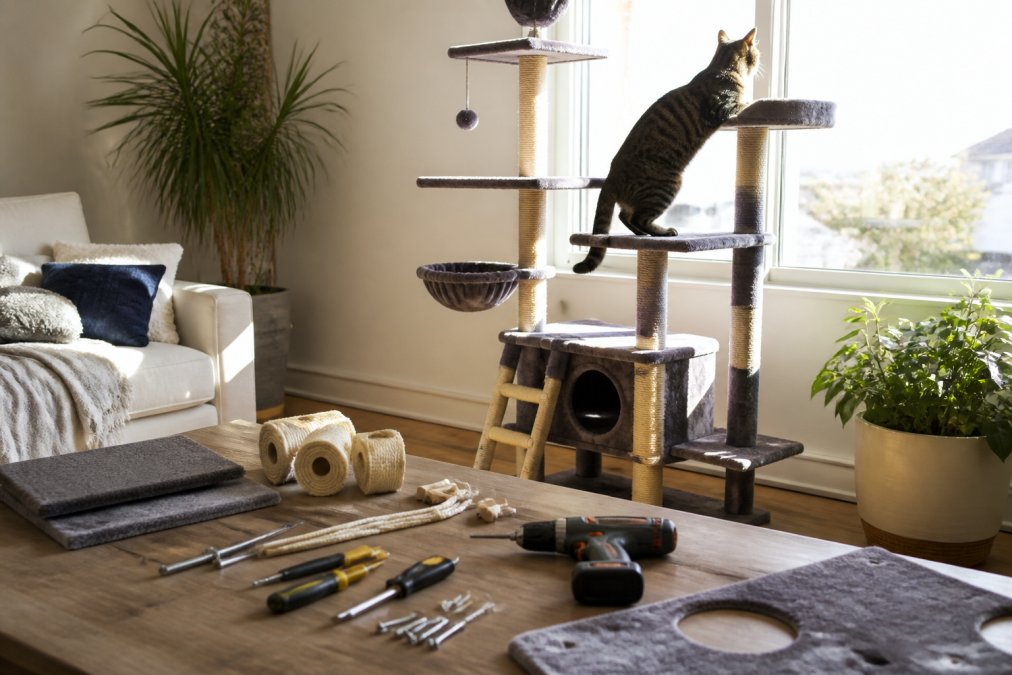
Catifying your home means creating a three-dimensional environment that satisfies your cat's territorial and climbing instincts. Vertical territory is critical, cats feel secure and stimulated when they can climb, perch, and observe from elevated positions.
Vertical territory and climbing structures
Cats need vertical space more than they need horizontal floor space. A single cat tree in a corner is a start, but true catification involves creating climbing pathways throughout your home using shelves, wall-mounted perches, and multi-level structures.
Install shelves at varying heights along walls. Cats don't need wide shelves, 20-30 centimetres is sufficient. The appeal is the height and the view, not the space. A cat that can climb to a high shelf gains a sense of security and territory control that dramatically reduces stress.
Cat trees should be sturdy enough that they don't wobble when your cat lands on them. An unstable tree trains your cat to avoid it. Invest in solid construction, a well-made tree becomes a permanent fixture your cat uses daily for years.
Position climbing structures near windows, near your main living areas, and in quiet corners. Variety in location means your cat can choose between social observation and private retreat depending on mood.
Window perches and sensory stimulation
Window perches provide visual stimulation and sensory engagement. A cat watching birds, squirrels, or passing pedestrians receives constant environmental input that keeps their mind active.
Install perches at comfortable heights for your cat's age and mobility. Senior cats benefit from lower perches that don't require difficult jumps. Position perches where they catch natural light, cats naturally gravitate toward warm, sunny spots.
Window watching becomes even more engaging if you create a bird feeder or bird bath visible from the window. The movement and activity outside provides hours of free entertainment.
DIY enrichment on a budget
You don't need expensive cat furniture to create an enriched environment. Cardboard boxes, paper bags, and simple household items provide surprisingly effective enrichment.
Stacked cardboard boxes create climbing structures at zero cost. Cut holes in the sides to create tunnels and hiding spots. Cats find the texture, smell, and structural variety of cardboard fascinating. Replace boxes as they degrade, the novelty of new cardboard keeps interest high.
Paper bags (with handles removed for safety) become hiding spots and play spaces. Crumpled paper inside creates interesting textures and sounds.
Enrichment Strategies for Senior Cats and Multi-Cat Homes
Senior cats need different enrichment than younger adults. Their enrichment should focus on gentle cognitive stimulation and low-impact physical activity rather than intense hunting play.
Rotating Toys and Preventing Boredom Long-Term
Toy rotation is the simplest, most effective strategy for maintaining long-term engagement. A toy your cat ignored becomes fascinating after three weeks in storage.
Frequently Asked Questions
How do I know if my indoor cat is bored?
Bored cats often display destructive behaviour, excessive meowing, or aggression toward people or other pets. They may also sleep more than usual or show little interest in their surroundings. Watch for repetitive behaviours like pacing, overgrooming, or attacking furniture. These signs indicate your cat needs more mental and physical stimulation through interactive play and environmental enrichment.
How much daily playtime does an indoor cat need?
Most indoor cats benefit from 15-30 minutes of interactive play spread across two or three sessions daily. This mimics their natural hunting patterns and helps maintain healthy weight and cognitive function. Senior cats may need shorter, gentler sessions, whilst younger, more active cats might enjoy extended play. Observe your cat's energy levels and adjust accordingly to keep them engaged without exhaustion.
What is environmental enrichment for cats?
Environmental enrichment involves modifying your home to stimulate your cat's natural behaviours through vertical spaces, puzzle feeders, window perches, and rotating toys. It addresses their prey drive, climbing instincts, and need for foraging. Enrichment reduces stress, prevents boredom-related behavioural problems, and improves overall wellness. Simple additions like cardboard boxes, climbing shelves, and interactive toys create a stimulating indoor environment that supports your cat's physical and mental health.
Are DIY cat enrichment toys as effective as purchased ones?
DIY enrichment can be highly effective and budget-friendly. Cardboard boxes, paper bags, crumpled paper balls, and toilet roll tubes provide genuine entertainment and foraging opportunities. The key is rotating these items regularly to maintain novelty and combining them with interactive play sessions. Whilst some purchased toys offer advanced features like motion sensors or puzzle mechanisms, simple DIY options satisfy many cats' enrichment needs when paired with consistent human interaction and environmental variety.