


Table of Contents
- What Is Mental Enrichment for Dogs?
- Why Mental Stimulation Matters for Your Dog
- How Mental Enrichment Improves Behaviour and Reduces Stress
- Dog Enrichment Activities to Keep Your Dog Engaged
- How to Mentally Tire Out a Dog Effectively
- Benefits of Puzzle Toys for Dogs
- Signs Your Dog Needs More Mental Stimulation
- Frequently Asked Questions
Last Updated: October 3, 2026
What Is Mental Enrichment for Dogs?
Mental enrichment for dogs is the practice of providing activities, toys, and experiences that stimulate a dog's mind and engage their natural problem-solving abilities. Unlike simple play, mental enrichment challenges dogs to think, explore, and use their cognitive skills in ways that mirror how they'd behave in natural environments.
Dogs need more than physical exercise to thrive. Mental enrichment taps into their instinct to forage, hunt, investigate, and solve problems, supporting their psychological well-being and building confidence.
Why Mental Stimulation Matters for Your Dog
Without mental stimulation, dogs develop behavioural problems including destructive chewing, excessive barking, and compulsive behaviours that signal stress and frustration.
Dogs experiencing cognitive challenges release endorphins, reducing anxiety and promoting calm. A mentally tired dog is often more relaxed than one who's only had physical exercise.
Focused problem-solving activities like sniffing activate the parasympathetic nervous system, making mental enrichment a genuine health intervention.
Dogs deprived of mental stimulation develop stereotypic behaviours like pacing or obsessive licking, signalling unmet cognitive needs.
The Kennel Club's guidance on canine welfare and enrichment emphasises that mental stimulation is as essential as physical activity for preventing behavioural issues and supporting long-term canine welfare.
How Mental Enrichment Improves Behaviour and Reduces Stress
Dogs given regular cognitive challenges show fewer problem behaviours: reduced aggression, less destructive activity, and improved impulse control.
Active engagement creates focused attention incompatible with anxiety-driven behaviours. A dog concentrating on a puzzle toy won't simultaneously exhibit stress-related behaviours.
Mental enrichment builds confidence. Dogs that solve problems develop competence, becoming less reactive and more resilient in other situations.
Enrichment activities give anxious dogs a constructive outlet and sense of control. Many behaviourists recommend enrichment as a first-line intervention for anxiety-related issues.
Dog Enrichment Activities to Keep Your Dog Engaged
Effective enrichment depends on your dog's age, physical ability, breed drive, and cognitive development stage. Puppies' needs differ fundamentally from senior dogs', and working breeds' drives differ from toy breeds'.
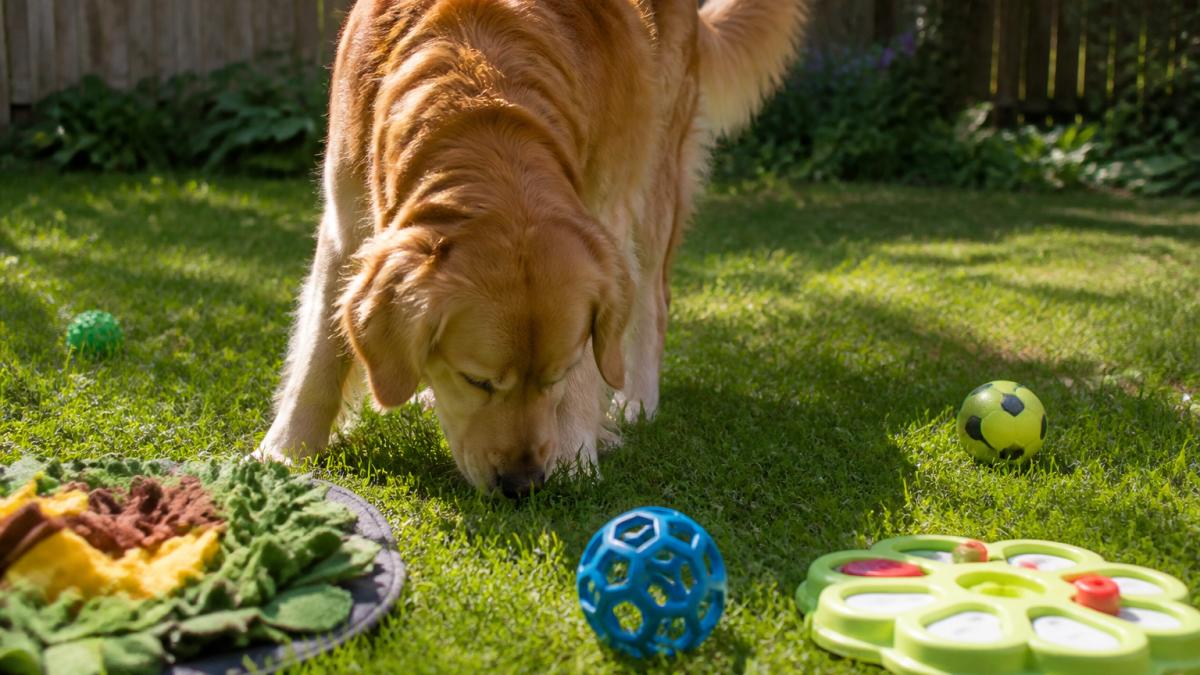
Enrichment for Puppies (8 Weeks to 12 Months)
Puppies need enrichment focused on novelty, safe exploration, and confidence-building rather than complex problem-solving. Activities must be supervised and age-appropriate.
Ideal puppy enrichment includes:
- Texture exploration: Introduce puppies to different surfaces (grass, gravel, sand, carpet) to build sensory awareness and reduce fear of novel environments.
- Safe chewing outlets: Provide appropriate chew toys (rubber rings, soft plush toys designed for puppies) to satisfy the natural urge to mouth and explore. Rotate toys every 2-3 days to maintain novelty.
- Gentle scent games: Hide treats in easily accessible locations (under a blanket, in a cardboard box) rather than complex puzzle toys. Puppies tire quickly; 5-10 minute sessions are optimal.
- Social play: Interaction with other vaccinated dogs (if socialised) and supervised play with family members builds confidence and teaches impulse control.
- Handling and grooming as enrichment: Getting puppies accustomed to touch, nail trimming, and grooming reduces stress later and counts as cognitive engagement.
Avoid complex puzzle toys and extended foraging sessions. Build positive associations with exploration and learning rather than mental exhaustion.
Enrichment for Adult Dogs (1-7 Years)
Adult dogs can handle sustained cognitive challenge and complex puzzle toys that tap into natural drives.
Tailor activities to breed tendencies: scent hounds and retrievers benefit from sniffing games and retrieval-based enrichment; herding breeds need puzzle toys and strategy games; toy breeds excel at interactive play and hide-and-seek; working breeds benefit from structured tasks and training integration.
Rotate enrichment types every 1-2 weeks to maintain novelty and prevent habituation.
Enrichment for Senior Dogs (7+ Years)
Senior enrichment should maintain mental engagement without physical strain or frustration.
Senior enrichment includes low-impact sniffing games, gentle puzzle toys with larger pieces, lick mats, sensory enrichment, and shorter frequent sessions (three 5-10 minute activities rather than one long session).
If a puzzle toy becomes too difficult, simplify or replace it. The goal is engagement, not stress.
Breed-Specific Enrichment Considerations
Breed history shapes enrichment preferences. Spaniels find sniffing and retrieval rewarding; Terriers prefer digging or burrowing activities. Recognising these drives allows you to design intrinsically rewarding enrichment.
The Kennel Club breed guides on natural behaviours and enrichment provide breed-specific recommendations for matching enrichment to instinctive drives.
How to Mentally Tire Out a Dog Effectively
Mental exhaustion is often more lasting than physical tiredness. Effective enrichment requires supervision, safety awareness, and measurement of actual benefit.
The Enrichment Session Framework
A structured session combines: warm-up (5 min, familiar activity), primary challenge (10-15 min, puzzle or foraging), variation (5-10 min, different enrichment type), and cool-down (5 min, calming activity).
Daily enrichment (15-20 minutes) produces better results than occasional long sessions. Dogs show measurable improvements in focus and problem-solving within 2-3 weeks.
Safety Protocols for DIY and Commercial Enrichment
Never leave puzzle toys or DIY enrichment unsupervised. Inspect regularly for loose pieces. Avoid small objects like beans or coins. Remove immediately if your dog shows distress, excessive drooling, or difficulty swallowing.
Material toxicity
- Ensure any materials used in DIY enrichment are non-toxic. Avoid chocolate, grapes, raisins, onions, and xylitol-containing products, all toxic to dogs.
- Check that paints, dyes, or adhesives used in DIY projects are pet-safe. Many craft materials contain harmful chemicals.
- If using essential oils for scent enrichment, verify they are dog-safe and diluted appropriately. Concentrated oils can cause respiratory irritation.
Frustration and stress
- If an enrichment activity is too difficult, your dog may become frustrated rather than engaged. Watch for signs: repeated failed attempts, whining, abandonment of the activity, or redirected stress behaviours (excessive panting, pacing).
- Adjust difficulty downward if frustration appears. A properly calibrated enrichment activity will hold your dog's complete attention without causing distress.
- Never use enrichment as punishment or withhold it as a consequence for misbehaviour. This creates negative associations with cognitive engagement.
Physical strain
- For senior dogs or those with joint issues, avoid enrichment requiring jumping, climbing, or sustained standing. Sniffing games at ground level or lick mats are safer alternatives.
- Monitor for signs of physical fatigue: excessive panting, limping, reluctance to continue, or collapse. Stop the activity immediately if these appear.
Measuring Enrichment Success: Observable Metrics
Many owners provide enrichment without verifying it's actually working. Tracking observable changes helps you confirm your dog is benefiting and adjust activities as needed.
Behavioural improvements to monitor:
- Reduction in destructive behaviours: Track instances of destructive chewing, excessive barking, or pacing. A dog receiving adequate enrichment should show measurable decreases within 1-2 weeks.
- Improved settling ability: Note how long your dog can rest calmly after enrichment. A well-enriched dog should settle for 1-2 hours post-activity. If your dog rebounds to restlessness within 15 minutes, enrichment intensity may be insufficient.
- Increased focus during training: Dogs receiving regular cognitive stimulation often show improved attention and faster learning in obedience or training sessions.
- Reduced attention-seeking: A mentally stimulated dog is less likely to demand constant attention, bark for engagement, or exhibit separation anxiety.
Engagement indicators during enrichment:
- Duration of focus: Time how long your dog engages with an enrichment activity before losing interest. Healthy engagement should last at least 10-15 minutes for adult dogs. If your dog abandons the activity in under 5 minutes, it may be too easy or too difficult.
- Problem-solving persistence: Does your dog attempt multiple strategies to solve a puzzle toy, or give up immediately? Persistence indicates appropriate challenge level.
- Repeat engagement: If you offer the same enrichment activity again, does your dog engage with similar enthusiasm? Declining interest suggests habituation, time to rotate to a new activity.
Physical and emotional signs of successful enrichment:
- Relaxed body posture and soft eyes during and after enrichment (indicates engagement without stress).
- Willingness to return to the enrichment activity on subsequent days.
- Reduced stress indicators: lower cortisol levels (observable as calmer demeanour, better sleep, reduced anxiety).
Tracking system Consider keeping a simple log: date, enrichment activity type, duration, engagement level (1-5 scale), and any behavioural changes observed. After 2-3 weeks, patterns will emerge showing which activities your dog finds most rewarding and which need adjustment.
Benefits of Puzzle Toys for Dogs
Puzzle toys are structured enrichment tools designed specifically to engage problem-solving skills. They offer consistency, adjustable difficulty levels, and measurable cognitive challenge.
The primary benefit is sustained mental engagement. A quality puzzle toy keeps your dog occupied for extended periods, providing relief for busy owners while supporting your dog's cognitive health. Unlike simple toys that lose appeal quickly, puzzle toys maintain novelty through repeated use because the challenge remains fresh.
Puzzle toys also encourage natural behaviours. Many are designed to replicate foraging or hunting sequences, allowing your dog to express instinctive drives in appropriate ways. This prevents those drives from manifesting as destructive behaviour.
Different puzzle toys serve different purposes. Some require manipulation and rotation; others demand persistence and strategy. Rotating between different types prevents your dog from becoming bored and ensures comprehensive cognitive stimulation.
Signs Your Dog Needs More Mental Stimulation
Recognising when your dog isn't getting enough mental enrichment is crucial. Common indicators include destructive chewing (especially on furniture or household items), excessive barking or vocalization, and repetitive behaviours like pacing or obsessive licking.
Restlessness and inability to settle are also signs. A dog that can't seem to relax, constantly seeks your attention, or appears anxious may be experiencing cognitive understimulation. Some dogs express this as hyperactivity; others become withdrawn or lethargic.
Behavioural problems often emerge gradually. If your dog's behaviour has shifted, becoming more reactive, aggressive, or anxious, insufficient mental stimulation may be contributing.
Age also matters. Puppies and younger dogs typically need more cognitive challenge than senior dogs, though enrichment remains important throughout life. Adjusting enrichment to your dog's life stage ensures appropriate challenge levels.
Mental enrichment is foundational to canine welfare. Dogs that receive consistent cognitive stimulation show fewer behavioural problems, experience less anxiety, and enjoy better overall psychological health.
Quanolo offers a curated selection of innovative, practical solutions designed to simplify and enhance your everyday life, including pet care products that support cognitive engagement and can transform your dog's behaviour and well-being. The Dogs Trust on canine enrichment and welfare recommends consistent mental stimulation as part of responsible dog ownership.
Shop now with Quanolo and give your dog the mental engagement they need to thrive.
Frequently Asked Questions
How much mental enrichment does a dog need daily?
Most dogs benefit from 15-30 minutes of dedicated mental enrichment daily, though this varies by age, breed, and individual temperament. Puppies and high-energy breeds may need more frequent sessions throughout the day. Spreading enrichment activities across multiple short sessions works better than one long session. Combine enrichment with physical exercise for balanced stimulation.
Can mental stimulation help with dog anxiety?
Yes. Mental enrichment reduces anxiety by engaging the parasympathetic nervous system, which promotes calm and relaxation. Problem-solving activities and foraging games redirect anxious energy into focused tasks. However, enrichment works best alongside consistent routines and, if needed, professional training support. Puzzle toys and sniffing activities are particularly effective for anxious dogs.
What are the signs of a bored dog?
Bored dogs often display destructive behaviours like chewing furniture, excessive barking, or digging. They may show restlessness, pacing, or constant attention-seeking. Some develop stereotypic behaviours such as spinning or obsessive licking. Lack of interest in walks or play, and increased sleeping, can also indicate insufficient mental stimulation. Addressing boredom early prevents these behavioural issues from becoming habits.
Do dogs get tired from mental stimulation?
Yes, mental stimulation is as tiring as physical exercise, sometimes more so. Problem-solving activities and cognitive challenges exhaust the brain, leading to natural tiredness and relaxation. A mentally stimulated dog often needs less physical exercise to feel satisfied. This is particularly valuable for dogs with mobility issues or during bad weather when outdoor activity is limited.