


Table of Contents
- Why Vertical Space Matters for Cats in Small Homes
- How to Choose a Cat Tree for Compact Living
- Wall-Mounted Cat Shelves as Space-Saving Alternatives
- Essential Features for Active Cats in Tight Spaces
- Rental-Friendly Mounting and Installation
- Maintaining Your Cat Tree in Limited Space
- Frequently Asked Questions
Last Updated: September 27, 2026
Why Vertical Space Matters for Cats in Small Homes
Cats need territory. In compact flats, vertical space becomes essential to provide the exploration and climbing they'd otherwise spread across multiple rooms.
Stacking upwards gives your cat multiple levels to explore, climb, and rest without consuming floor space. A cat tree transforms a corner into a three-dimensional environment with perches, hideaways, and scratching posts within a footprint smaller than a single armchair.
Cats instinctively seek elevation for security, vantage points, and escape routes. In small apartments, vertical territory prevents boredom and stress.
Without vertical enrichment, cats resort to destructive behaviour: scratching furniture, knocking things off shelves, or withdrawing. A well-designed cat tree channels these instincts productively while maximising vertical territory without dominating your living space.
How to Choose a Cat Tree for Compact Living
Selecting the right cat tree for a small apartment requires balancing floor space, stability, and enrichment features within spatial constraints.
Floor Footprint and Stability
Measure the area where you plan to place the tree. A compact cat tree should occupy no more than 0.5 square metres, typically a base around 60 centimetres by 60 centimetres or smaller.
Stability matters more in small spaces because your cat has limited room to adjust weight during climbing. Look for designs with a wide, weighted base plate that prevents tipping when your cat jumps between levels.
The base should counterbalance the height. Test stability by applying downward pressure to upper levels; quality cat trees for small apartments resist wobbling under vigorous movement.
Solid wood frames outperform particle board, especially for active cats. If the tree sways when pushed, it's unsuitable for dynamic behaviour.
Material Quality and Durability
Cheap materials fail quickly under cat claws. Sisal rope degrades fast on low-quality trees, unravelling within months to expose the cardboard core.
Dense, tightly woven fabrics resist shredding better than loose weaves. Tightly woven polyester or canvas lasts longer than plush microfibre under regular scratching.
Use solid pine or plywood, not particle board. Joints should be reinforced with brackets or dowels. Check whether the manufacturer offers replacement parts so you can replace worn rope or damaged platforms without replacing the entire structure.
Non-toxic materials matter if your cat spends hours on the tree. Look for certifications or explicit statements about material safety.
Wall-Mounted Cat Shelves as Space-Saving Alternatives
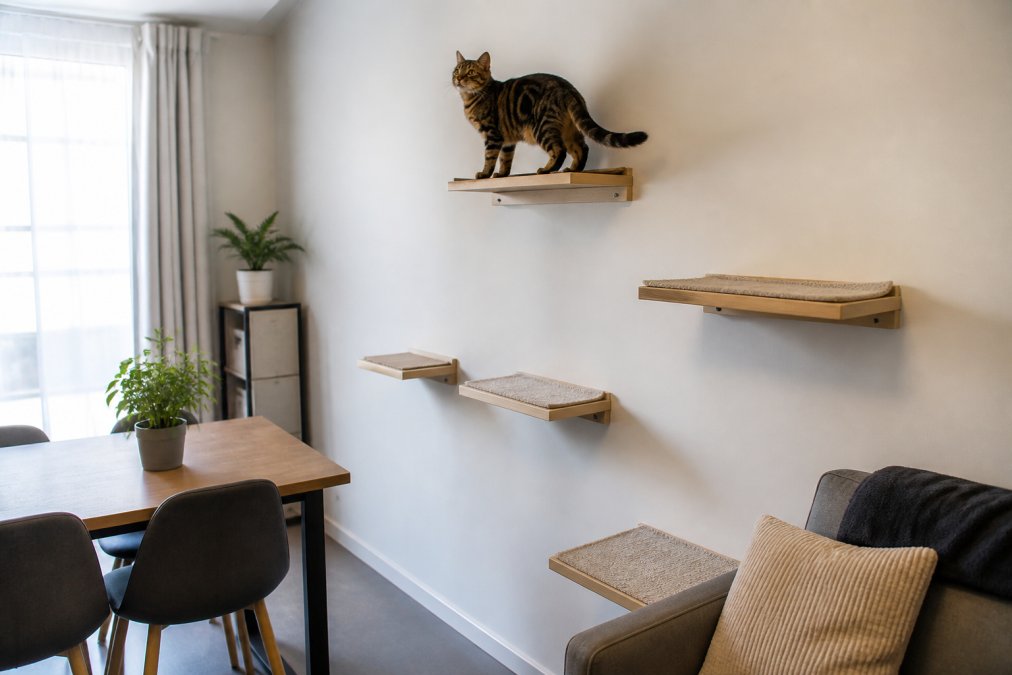
Wall-mounted shelves create vertical territory without occupying floor footprint, ideal for studios or one-bedroom flats where space is limited.
Install shelves at staggered heights 30-45 centimetres apart for comfortable jumping. The highest shelf should be at least 1.2 metres above the floor.
Installation requires wall anchors rated for shelf, hardware, and cat weight. Rental flats present challenges as many landlords prohibit wall drilling. Adhesive strip systems are less stable for active cats.
Advantages include layout flexibility. Disadvantages include installation difficulty and permanent wall marks. Multi-cat households may need multiple installations to prevent territorial conflicts.
Essential Features for Active Cats in Tight Spaces
Active cats in small apartments need enrichment features within a compact footprint while minimising acoustic impact on neighbours in shared buildings.
Scratching Posts and Upholstery Options
Cats scratch to mark territory, maintain claw health, and stretch muscles. Without appropriate scratching surfaces, they'll target your furniture and walls.
Sisal rope is the gold standard for scratching posts, durable, satisfying, and long-lasting. It resists unravelling better than rope on particle board and dampens sound by absorbing vibration rather than transmitting it.
Cardboard pads are cheap and replaceable but shed dust and wear faster than rope. They amplify scratching sounds that travel through apartment walls. Use them alongside rope posts, not as the only option if concerned about noise complaints.
Carpet surfaces work for horizontal scratching but are significantly louder than sisal. If your apartment has neighbours below, prioritise sisal rope and minimise carpet scratching surfaces.
Combine scratch surfaces strategically, rope posts and cardboard pads provide variety. In apartments, weight the design toward sisal rope to reduce noise transmission to neighbours.
Perches and Hideaway Spaces
Cats need both exposure and privacy. High perches provide vantage points and security; hideaway spaces offer refuge when stressed or resting.
Balance open platforms with enclosed hideaways. A tree with three open perches and one enclosed box covers different personality types.
Perches should be at least 20 centimetres wide for comfortable stretching. Raised edges prevent rolling off during sleep.
Hideaway boxes should have two entrance holes so cats can escape quickly. The interior should be dark and insulated, offering genuine refuge.
Acoustic Dampening: The Overlooked Apartment Problem
Active cats jumping between levels create impact sound that transmits through apartment structures to neighbours. This is a genuine neighbour relations issue most guides ignore.
Soft, padded platforms absorb impact sound better than hard surfaces. Platforms with felt or rubber undersides dampen noise; hard plastic or thin plywood transmit sound efficiently.
A solid, weighted base transmits less vibration than a wobbling tree. Wobbling creates low-frequency noise noticeable to neighbours. Stability affects acoustic performance as much as safety.
Position the tree away from shared walls and over the thickest part of your floor to reduce noise transmission. Avoid placing it directly above a neighbour's bedroom or living room. Position it over hallways, kitchens, or bathrooms if possible.
Rubber or cork matting underneath the tree's base absorbs vibration. A 10 mm thick rubber mat (£15-25) significantly reduces impact noise, especially on hardwood or laminate flooring.
Enclosed hideaway boxes reduce jumping frequency. Cats that use them regularly have fewer active jumping sessions overall.
Rental-Friendly Mounting and Installation
Renting complicates cat tree selection. Most landlords prohibit permanent wall modifications, and damage-free solutions carry hidden risks.
Freestanding Trees: The Default Rental Solution
Freestanding trees require no drilling or landlord approval and are portable. The trade-off: they need larger floor footprints for stability. A 1.8-metre tree needs a 70 cm × 70 cm base, which defeats the purpose of a compact tree.
On hardwood or laminate floors, a weighted base grips well. On carpet, the base can shift sideways, creating wobble. Test the tree on your actual flooring type before committing.
Weight capacity is critical in rentals since you can't anchor to walls. Look for trees rated at least 15 kg if your cat is active or for multiple cats.
Adhesive-Mounted Shelves: The Damage-Free Wall Option
Some wall-mounted systems use heavy-duty adhesive strips instead of screws. These are semi-permanent but have significant limitations.
Adhesive strips work best on clean, smooth surfaces. Textured walls reduce adhesive contact.
Pressure-Mounted Systems: Tension Between Floor and Ceiling
Pressure-mounted trees use tension rods between floor and ceiling, requiring no drilling or adhesive. They're damage-free and adjustable to different ceiling heights (2.3-2.7 metres).
Documenting Your Installation for Deposit Protection
Protect yourself by documenting the apartment's condition with dated photos of walls, ceiling, and floor. Store photos with your tenancy agreement.
Maintaining Your Cat Tree in Limited Space
Compact spaces mean compact maintenance. Dust, hair, and debris accumulate faster on smaller surfaces. Regular cleaning keeps the tree hygienic and extends its lifespan.
Frequently Asked Questions
What is the best cat tree for a small space?
The best cat tree for small apartments combines a compact floor footprint with vertical climbing space. Look for designs that are no more than 60-80 cm wide, feature multiple levels to maximize territory without spreading outward, and include stable base plates to prevent wobbling. Sisal rope posts and upholstered perches provide enrichment without bulk. Wall-mounted shelves are an excellent alternative if floor space is extremely limited, allowing your cat full vertical access without occupying any ground area.
How do I choose a cat tree for small flats?
Measure your available floor space first, then prioritise height over width. A tall, narrow design gives cats the vertical territory they need for climbing and lounging whilst keeping your footprint minimal. Check the weight limit to ensure stability with your cat's size. Assess materials for durability and scratch resistance, and consider whether you need rental-friendly options that don't require permanent wall mounting. Test assembly difficulty before purchasing, as compact designs should still be straightforward to set up.
Are wall-mounted cat shelves better than floor cat trees for small apartments?
Wall-mounted cat shelves excel when floor space is critical, freeing up every centimetre of ground area. They provide excellent vertical enrichment and climbing opportunities for active cats. However, they require secure wall installation and landlord approval in rental properties. Floor-based cat trees offer easier installation, portability, and work in any apartment without wall damage. The best choice depends on your space constraints, rental situation, and cat's climbing preferences. Many owners combine both for maximum feline enrichment.
What features make a cat tree stable and safe in a small apartment?
Stability depends on a wide, heavy base plate that prevents wobbling during climbing and jumping. Look for non-toxic materials and scratch-resistant upholstery that withstand active use. Multi-level designs should have secure platform connections and appropriate weight limits for your cat. Sisal rope posts offer better grip than carpet for climbing safety. Test stability before purchase by checking customer reviews for motion or movement during use. A stable tree keeps your cat safe and protects your apartment walls and furniture from damage.